 |
|
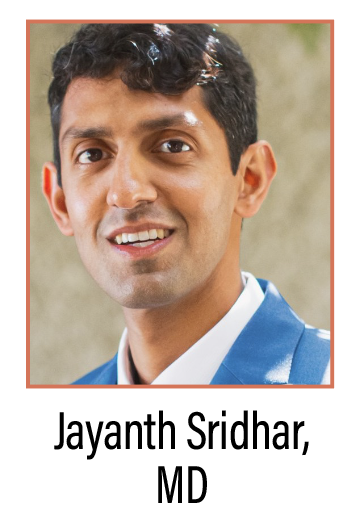
Bio Dr. Sridhar is an associate professor of clinical ophthalmology at Bascom Palmer Eye Institute, Miami. DISCLOSURES: Dr. Sridhar is a consultant to Alcon, DORC, Genentech/Roche and Regeneron Pharmaceuticals. |
When I first began recording a retina-focused podcast nearly a decade ago, digital education felt like an experiment. In 2016, podcasting was a curiosity—an emerging format somewhere between radio and lecture hall. Few journals had video archives, webinars were clunky and the idea that a retina surgeon might one day teach through a smartphone seemed improbable. Yet, less than 10 years later, the world of ophthalmic education looks almost unrecognizable.
What changed was not just technology—it was the culture of how we share, learn and connect as physicians.
The beginnings
In the mid-2010s, online medical education was still slow and centralized. Conference talks and society webinars dominated, and interactivity was limited to an occasional email follow-up. Podcasts and early YouTube channels were informal side projects—a way to share case discussions and journal insights with a wider audience. There was a sense of intimacy to it: a conversation between colleagues that happened to be broadcast.
Early listeners were residents on commutes, fellows between cases and attendings curious about new surgical approaches. Each episode or video felt handcrafted, more like a case report than a formal show. But as bandwidth expanded and social media matured, the scale of engagement changed dramatically.
The platform explosion
 |
By the early 2020s, the educational landscape had fragmented and multiplied. The same conference that once depended on a few in-person sessions now spawned simultaneous streams, highlight clips and analysis posts across multiple platforms. Educational voices emerged on YouTube, TikTok, Instagram and LinkedIn, bringing surgical tips and study summaries to global audiences.
A one-minute reel demonstrating internal limiting membrane peeling might rack up 50,000 viewers overnight. A TikTok explaining diabetic macular edema could reach more people than a traditional CME lecture. Residents began sharing their own micro-lessons, while societies and journals hired media teams to produce podcasts, animated abstracts and cross-platform discussions.
For ophthalmology—and retina in particular—this explosion has been both thrilling and humbling. Knowledge that once required journal access and travel funding is now free and immediate. The boundaries between student, teacher and audience have blurred beyond recognition.
The price of accessibility
Democratization has a cost. The same accessibility that fuels innovation also invites misinformation and oversimplification. Algorithms reward emotion over nuance; a carefully designed study summary can be buried beneath a flashy but inaccurate claim about “miracle injections.”
Even within professional circles, the pressure to stay visible online can distort priorities. Educational intent can drift toward self-promotion, and the line between influence and information grows faint. Yet, physicians shouldn’t retreat from the digital space—it’s precisely why credible clinicians must participate. Our presence ensures that accurate, ethical perspectives remain accessible amid the noise.
The modern classroom
Today, podcasting and short-form video have become default learning environments. CME courses and fellowship curricula now routinely include digital content, and many programs encourage residents to create educational media as part of training.
The most striking development isn’t the technology itself but rather the community built around it. Podcasts create ongoing conversations that evolve with the field. Social platforms host journal clubs that span continents. Surgeons trade pearls via comments and DMs. The new classroom mirrors what medicine has always valued: mentorship; curiosity; and shared problem-solving—now transposed into pixels and audio waves.
Looking ahead
As we enter the second half of the decade, artificial intelligence and adaptive learning will likely define the next frontier. Algorithms already shape what learners see; soon, they may build personalized curricula. AI voice translation could make every podcast multilingual, and augmented reality could turn a surgical video into a virtual wet lab.
The question isn’t whether these tools will arrive—they already have—but whether we can guide their use responsibly. How do we preserve clinical judgment in a world of instant answers and balance accessibility with accuracy?
Perhaps the answer lies in recognizing that the medium has never been the real message—the relationships are.
The continuity of connection
After nearly a decade of watching digital education evolve, one lesson stands out: Technology changes, but curiosity doesn’t. Online education isn’t replacing traditional teaching—it’s extending it. The reach is broader, the cadence faster and the medium more visual, but the essence remains mentorship through conversation. Whether through a microphone, a one-minute reel or a virtual panel spanning time zones, we’re continuing the oldest tradition in medicine—sharing what we’ve learned so someone else can do it better.
That, perhaps, is the truest measure of progress: not the format, but the fidelity of connection it sustains. RS